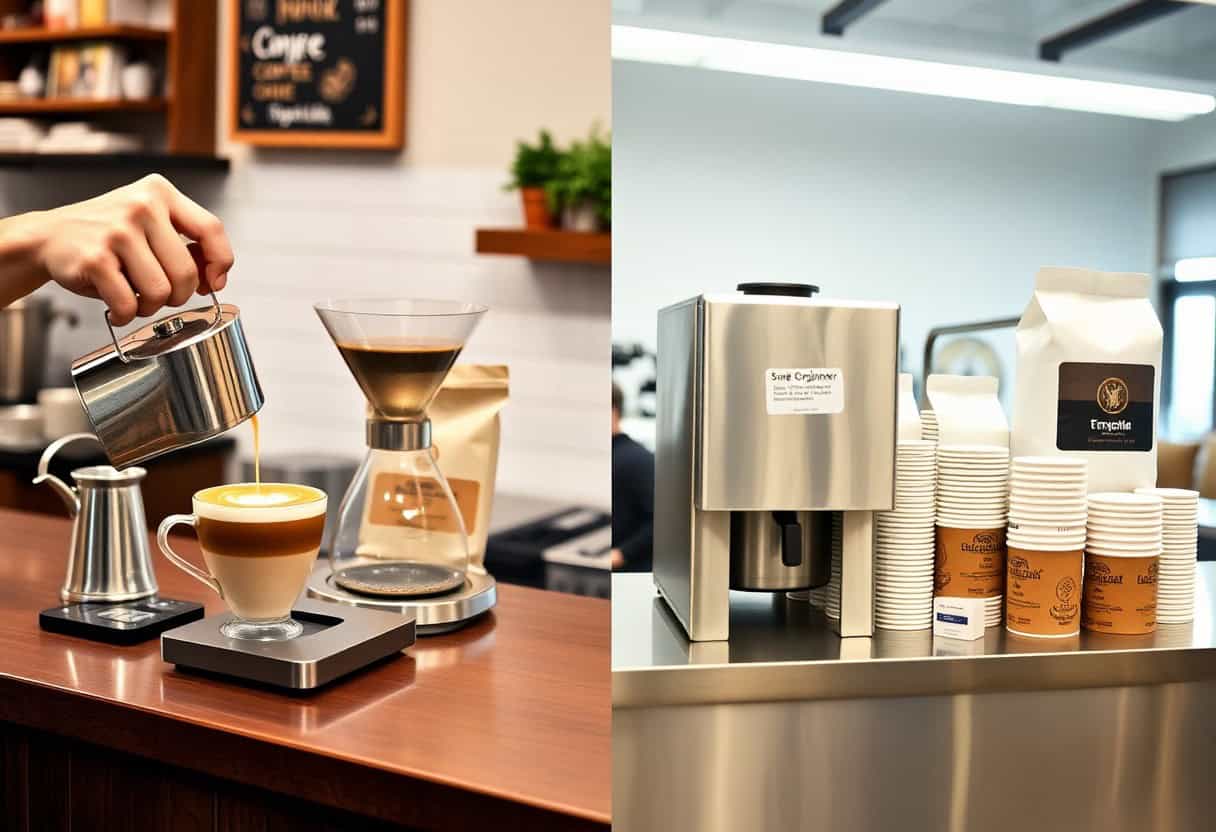
TL;DR: Commercial coffee and specialty coffee are not the same product. This guide breaks down 7 proven differences so you know what commercial coffee really delivers and when it is worth paying more.
Table of Contents
Over 90% of commercial coffee is mass-produced with little regard for origin or flavor, while specialty coffee scores 80+ on a 100-point scale and emphasizes quality at every step. You taste the difference in the freshness, sourcing, and craftsmanship behind each cup. Dangerous levels of pesticides and additives often appear in commercial blends, unlike the transparent, ethical practices defining specialty coffee.
Key Takeaways:
- Specialty coffee is defined by high-quality beans scoring 80+ on a 100-point scale, while commercial coffee often prioritizes volume and consistency over bean origin or flavor complexity.
- Origin transparency matters more in specialty coffee-consumers often know the farm, harvest date, and processing method, unlike most commercial blends that mix beans from multiple sources.
- Roasting approaches differ: specialty roasters use lighter roasts to highlight unique flavor notes, whereas commercial roasters typically use darker roasts for a uniform, bold taste.
- Price reflects the difference in production-specialty coffee involves careful harvesting, sorting, and small-batch roasting, contributing to higher costs compared to mass-produced commercial coffee.
- Brewing method influences the experience-specialty coffee is often prepared using manual techniques like pour-over or Aeropress to emphasize flavor clarity, while commercial coffee is commonly served via automated drip machines or espresso systems.
Commercial Coffee: The Sourcing Grift: Farm to Table vs. Bulk to Bin
Who Grew Your Coffee?
You’re not just drinking a beverage when you sip specialty coffee-you’re tasting a story. That story begins with a farmer, often on a small plot of land in Ethiopia, Colombia, or Guatemala, who tends to each plant by hand, harvests only the ripest cherries, and takes pride in quality over quantity. These farmers are named, their farms mapped, and their practices documented-transparency is non-negotiable in the specialty world. When you buy a bag labeled with a single estate or cooperative, you’re supporting individuals whose livelihoods depend on fair compensation and sustainable growing methods.
What Happens in the Shadows of Scale
Commercial coffee operates on a different logic: volume. Beans from dozens of countries are blended, traded like commodities, and treated as interchangeable. You’ll rarely know where your supermarket roast originated, let alone who picked the cherries. Middlemen dominate the supply chain, and farmers are often paid below the cost of production. This system prioritizes consistency for mass palates, not flavor integrity or ethical sourcing. The result? A disconnect so wide that the person who grew your coffee may never afford to taste the final product.
Traceability as a Promise
Specialty roasters publish farm details, elevation, varietal, and processing method because they treat coffee as an agricultural product with terroir, not a generic ingredient. This traceability isn’t marketing fluff-it’s a commitment to accountability. When a roaster visits farms, pays above-market prices, and builds long-term relationships, it changes the power dynamic. You benefit from fresher, more distinctive coffee, while farmers gain stability. In contrast, commercial sourcing funnels beans through anonymous auctions and export conglomerates, where quality is averaged out and ethics are buried in paperwork.
The Cost of Convenience
Choosing bulk-sourced coffee might save you a few dollars per bag, but the hidden costs are steep. Low prices pressure farmers to cut corners, exploit labor, or abandon coffee altogether. Monoculture farming, chemical overuse, and deforestation are common in regions supplying commercial brands. Specialty coffee, by focusing on direct trade and micro-lots, resists this downward spiral. It proves that coffee can be both exceptional and ethical. Every time you choose a transparently sourced bag, you vote for a system that values people and planet as much as profit.
The Alchemy of the Roast
How Heat Transforms the Bean
You’ve likely noticed how two coffees from the same region can taste nothing alike. The reason often lies in the roast. Roasting isn’t just about darkening the bean-it’s a precise thermal process that unlocks hundreds of flavor compounds. When green coffee meets heat, chemical reactions like the Maillard reaction and caramelization begin, forming the aromas and tastes you experience. Under-roasting can leave beans grassy and acidic, while over-roasting risks scorching and a bitter, hollow profile. The skill of the roaster determines whether those delicate floral notes in an Ethiopian bean survive or get buried under char.
Profile Over Darkness
Commercial roasters often prioritize consistency and shelf life, which leads to darker, more uniform profiles. These roasts mask inconsistencies in lower-grade beans and produce a familiar, bold flavor many associate with “coffee.” Specialty roasters, in contrast, tailor each roast to highlight a bean’s origin character. This means lighter roasts are common-not because they’re trendy, but because they preserve the bean’s natural sweetness, acidity, and complexity. You might taste blueberry in one, jasmine in another, or brown sugar in a third-all shaped by how the roaster applied heat.
The Human Hand Behind the Machine
Automation dominates commercial roasting, where large batches are programmed to follow preset curves. While efficient, this approach leaves little room for real-time adjustments. Specialty roasting is more like conducting a live performance. The roaster monitors bean color, temperature, and aroma, making split-second decisions to alter airflow or heat. This hands-on control is what allows subtle terroir expressions to shine. When you sip a well-roasted specialty coffee, you’re tasting not just the farm and the varietal, but the roaster’s judgment and intent.
Quality Control and the Q-Grader’s Verdict
The Role of the Q-Grader
You’ve likely heard the term “Q-Grader” tossed around in specialty coffee circles, but what does it actually mean? A Q-Grader is a certified professional trained by the Coffee Quality Institute to evaluate coffee using a rigorous, standardized scoring system. These experts assess over 100 individual attributes-from aroma and acidity to body and aftertaste-assigning points based on precise criteria. Only coffees that score 80 points or above on a 100-point scale are classified as specialty grade. This level of scrutiny ensures that every cup labeled “specialty” meets a measurable standard of excellence, not just marketing hype.
How Commercial Coffee Falls Short
Commercial coffee rarely undergoes this kind of evaluation. Instead, quality control often prioritizes consistency and cost-efficiency over sensory excellence. Beans may be blended from multiple origins, including lower-grade lots, and roasted to mask defects rather than highlight origin characteristics. Without independent sensory analysis, flaws like mold, fermentation, or over-roasting can go undetected-or worse, become part of the expected flavor profile. You’re not just paying less for commercial coffee; you’re often accepting a product with unverified quality and hidden defects.
The Proof Is in the Cupping Table
At the cupping table, where Q-Graders conduct their evaluations, the difference becomes undeniable. Specialty coffees display clarity, balance, and complexity-flavors that reflect their terroir, varietal, and processing method. Commercial coffees, by contrast, often score poorly in categories like sweetness, acidity, and uniformity. The Q-Grader’s verdict isn’t subjective opinion; it’s a repeatable, scientific assessment. When you choose specialty coffee, you’re aligning with a system that values transparency and precision. For a deeper breakdown of how these scores are assigned and what they mean, explore Specialty vs. Commercial Coffee | CoffeeReview.com.
Environmental and Ethical Realities
The True Cost of Commercial Coffee Production
You’re likely unaware of how deeply commercial coffee impacts ecosystems. Large-scale farms often clear vast tracts of forest to make room for monoculture plantations, leading to alarming rates of deforestation in regions like Central and South America. This loss of biodiversity disrupts natural pest control and soil health, forcing producers to rely on synthetic fertilizers and pesticides. These chemicals leach into waterways, contaminating local water supplies and harming aquatic life. When you choose mass-market coffee, you may unknowingly support practices that prioritize yield over planetary health.
How Specialty Coffee Supports Sustainable Farming
Smallholder farmers in the specialty coffee sector typically use shade-grown methods, preserving tree cover and protecting native species. These farms mimic natural forest environments, reducing soil erosion and maintaining healthier microclimates. Many specialty producers are certified organic or follow regenerative practices that rebuild soil fertility instead of depleting it. By paying fair prices for high-quality beans, specialty buyers give farmers the financial stability to invest in long-term sustainability rather than short-term survival. Your purchase becomes a vote for farming that works with nature, not against it.
Human Impact: Who Grows Your Coffee?
Behind every cup is a farmer whose livelihood depends on the price their beans fetch. In commercial supply chains, multiple intermediaries dilute profits, leaving growers with pennies per pound-often below the cost of production. This economic pressure leads to exploitative labor practices, including underpaid seasonal workers and child labor in some regions. Specialty coffee cuts out unnecessary layers, connecting roasters directly with farms. These relationships often include transparency reports, fair trade premiums, or direct contracts that ensure farmers earn a dignified income. When you drink specialty coffee, you’re more likely supporting human dignity, not just a caffeine fix.
The Carbon Footprint of Your Morning Brew
Transport and processing also shape coffee’s environmental toll. Commercial beans often travel thousands of miles in bulk, roasted in massive facilities powered by fossil fuels, then shipped again to retailers. Specialty coffee tends to move in smaller batches, with roasters choosing local distribution and energy-efficient operations. Some even offset emissions or use renewable energy. While no coffee is carbon-neutral, your choice influences how much strain each cup places on the climate. Opting for transparent, small-batch brands means you’re reducing your indirect contribution to greenhouse gas emissions-one thoughtful pour at a time.
The Sensory Experience: Notes vs. Noise
What Your Palate Actually Tastes
Every sip of specialty coffee invites you into a layered sensory journey shaped by origin, roast, and brewing precision. You’re not just drinking caffeine-you’re experiencing distinct flavor notes like citrus zest, dark chocolate, or jasmine, often revealed through careful tasting methods. These aren’t marketing buzzwords; they’re descriptors grounded in real chemical compounds developed during growth and roasting. When you taste a naturally processed Ethiopian coffee and detect blueberry sweetness, that’s not imagination-it’s terroir and technique working in harmony. Commercial coffee rarely offers this clarity, prioritizing consistency over character.
The Mask of Uniformity
Bitterness dominates most commercial brews, not because it’s desirable, but because it’s the easiest profile to mass-produce. Dark roasting hides defects and blends beans from multiple sources, erasing individuality in favor of a one-size-fits-all punch. What you get is sensory noise-charred, flat, or stale notes that overwhelm subtlety. This uniformity trains your palate to expect strength over nuance, making lighter, more complex coffees seem “weak” at first. The real danger lies in this conditioning: over time, you may lose the ability to detect delicate flavors, mistaking loudness for quality.
Training Your Senses
Your taste buds adapt based on what you expose them to, and specialty coffee challenges them to evolve. When you slow down and pay attention, you begin to notice acidity that sparkles like ripe fruit, or a finish that lingers like toasted almond. These aren’t fleeting impressions-they’re measurable attributes evaluated by trained tasters using standardized scoring systems. You don’t need certification to appreciate them, just curiosity and presence. Each cup becomes an opportunity to recalibrate your expectations, moving from passive consumption to active engagement.
Why Clarity Matters
A clean cup reveals truth-about the bean, the farmer, and the craft behind it. Specialty coffee highlights transparency, where origin, harvest date, and processing method are shared openly. You can taste the care in a honey-processed Costa Rican bean just as clearly as you can detect the neglect in an over-roasted blend. This clarity isn’t just about pleasure; it’s about respect for the entire chain, from soil to sip. Commercial coffee often obscures these details, wrapping mediocrity in bold branding and nostalgic slogans. Choosing clarity means choosing awareness.
Conclusion
Presently, you recognize that specialty coffee and commercial coffee differ in origin, process, and outcome. Specialty coffee emphasizes bean quality, precise roasting, and traceability, offering you a nuanced and intentional experience.
Commercial coffee prioritizes consistency and volume, often sacrificing flavor complexity for affordability and accessibility.
You choose based on what matters most-depth of flavor and ethical sourcing, or convenience and cost. Understanding these distinctions empowers your daily coffee decision with clarity and purpose.
Key Takeaways: Commercial Coffee
- Bean grade differs — commercial coffee blends lower-grade beans for consistency.
- Roasted dark — commercial coffee often hides flaws under a heavy roast.
- Built for scale — commercial coffee prioritises shelf life over flavour.
- Cheaper per cup — commercial coffee wins on price, not nuance.
- Know the trade-off — choose commercial coffee for value, specialty for flavour.
Choose the Right Commercial Coffee for You
Understanding commercial coffee helps you spend wisely. Keep exploring with these guides.
- Direct trade coffee — what it means
- The fair trade coffee guide
- The complete guide to coffee brewing methods
For standards that define quality grading, see the Specialty Coffee Association.
FAQs: Commercial Coffee
Q: What defines specialty coffee compared to commercial coffee?
A: Specialty coffee is defined by its high quality, traceability, and careful production methods. Beans are typically grown at optimal altitudes with attention to soil, climate, and harvesting techniques.
These coffees score 80 points or higher on a 100-point scale used by professional tasters. Commercial coffee, on the other hand, focuses on consistency and volume.
It often blends beans from multiple sources, prioritizing cost-efficiency over unique flavor profiles. The result is a more uniform taste that suits mass-market preferences.
Q: How do the flavor profiles differ between specialty and commercial coffee?
A: Specialty coffee offers complex and distinct flavors influenced by origin, varietal, and processing method. You might taste notes of citrus, berry, chocolate, or floral hints depending on the bean.
Roasters usually apply lighter roasts to preserve these characteristics. Commercial coffee tends to have a bolder, more uniform taste, often leaning toward roasted, smoky, or bitter notes.
This comes from darker roasting and blending practices designed to mask inconsistencies in lower-grade beans.
Q: Where does the coffee come from, and does origin matter?
A: Origin matters significantly in specialty coffee. Beans are often single-origin, meaning they come from a specific farm, region, or cooperative. This allows drinkers to experience the unique qualities of a particular terroir.
Transparency is key-roasters usually list the country, farm, elevation, and harvest date. Commercial coffee rarely highlights origin.
It typically uses a mix of beans from various countries to maintain a consistent flavor year-round, regardless of growing conditions or harvest quality.
Q: How are the beans roasted differently?
A: Specialty coffee roasters use precise, small-batch roasting to enhance the bean’s natural flavors. They adjust time and temperature to suit each batch, aiming to highlight sweetness, acidity, and aroma.
Roast profiles are documented and often shared with customers. Commercial coffee is usually roasted in large quantities with a one-size-fits-all approach.
The focus is on efficiency and durability, often resulting in a darker roast that produces a more bitter, less nuanced cup.
Q: Why is specialty coffee more expensive than commercial coffee?
A: Specialty coffee costs more because of the labor, care, and resources involved at every stage. Farmers receive higher prices for quality beans, and sustainable practices often increase production costs.
Smaller harvests, hand-sorting, and meticulous processing add to the expense. Roasters invest in equipment and expertise to bring out the best in each batch.
Commercial coffee benefits from economies of scale, lower-grade beans, and automated processes, allowing it to be sold at a lower price point despite higher overall output.