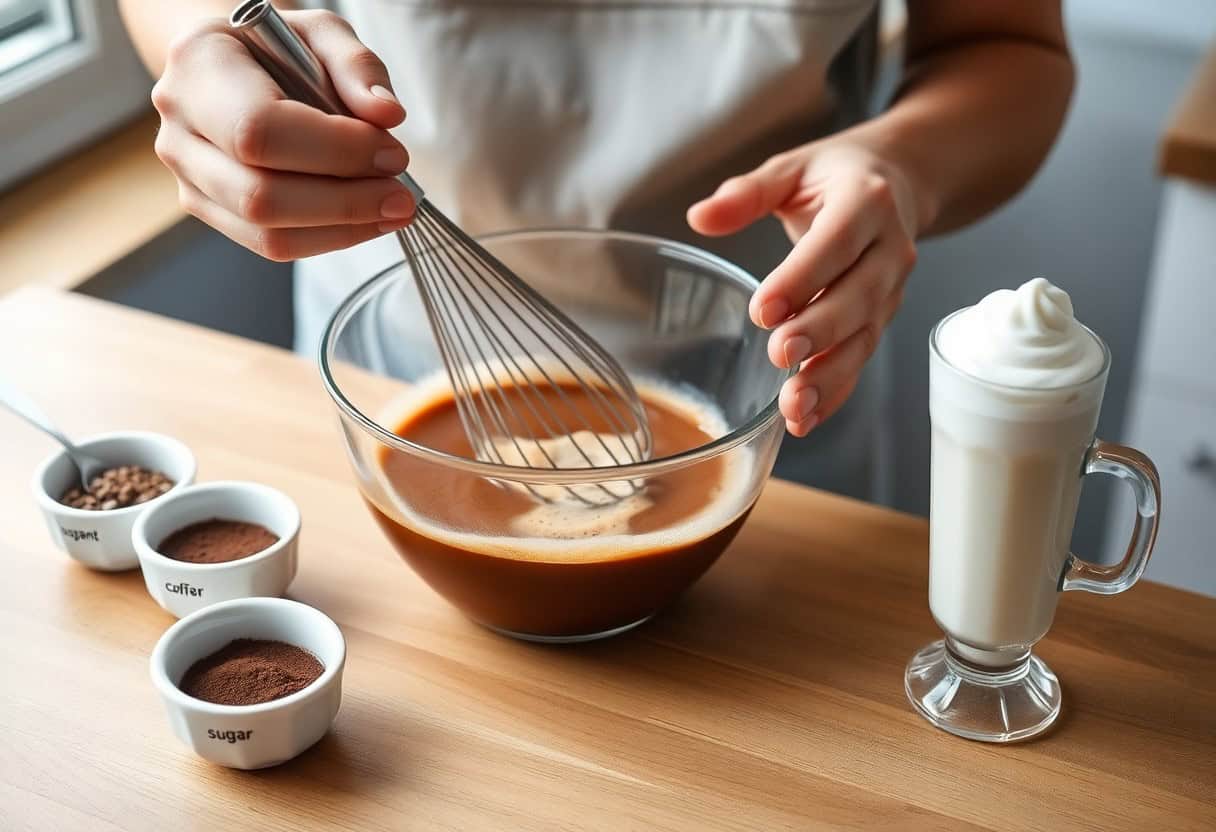
TL;DR — Dalgona whipped coffee: Dalgona whipped coffee made without an electric mixer. 5 proven steps for the cloud-soft topping in under 10 minutes.
Table of Contents

TL;DR: Want dalgona whipped coffee without an electric mixer? Use a whisk, jar, or French press to whip dalgona whipped coffee into stiff peaks in 5-7 minutes. Below are 7 brilliant methods to make dalgona whipped coffee at home, ranked by speed and arm fatigue.
Table of Contents
There’s a simple, satisfying way to enjoy fluffy dalgona coffee using just instant coffee, sugar, hot water, and a whisk or fork. You don’t need any special equipment-just consistent hand mixing for 3-5 minutes until the mixture becomes thick and golden. The result is a creamy, sweet topping that transforms milk into a café-style drink instantly.
Key Takeaways:
- Dalgona coffee requires only three ingredients: instant coffee, sugar, and hot water, all combined in equal parts.
- Use a fork or a hand whisk to whip the mixture-consistent circular or back-and-forth motion builds volume over 3 to 5 minutes.
- The mixture is ready when it becomes thick, light in color, and holds stiff peaks that slowly dissolve when touched.
- Pour the whipped coffee over cold or warm milk for a creamy, frothy drink-dairy or plant-based milk both work well.
- For faster results, use very hot water to dissolve the sugar and coffee quickly, which helps speed up the whipping process.
The Science Behind the Froth
Creating dalgona coffee by hand relies on physical and chemical principles you’re already using with every vigorous stir. Instant coffee contains dried coffee particles and small amounts of soluble compounds that act as natural surfactants, helping to stabilize air bubbles when agitated. Without these stabilizers, your mixture would collapse quickly. The foam forms because you’re trapping air within a network of coffee oils, sugar, and water, creating a semi-solid structure that holds its shape.
Why instant coffee is important for stabilization
Instant coffee dissolves completely and contains concentrated coffee solids that support foam formation. These particles help reduce surface tension in the liquid, making it easier to trap air during whipping. Unlike brewed coffee, which lacks sufficient solids, instant coffee provides the structural backbone needed. Without it, your mixture won’t stiffen, no matter how long you stir.
The chemical reaction between sugar and hot water
Sugar dissolves in hot water, creating a syrupy solution that increases viscosity and supports bubble formation. As you mix, the thickened liquid slows down drainage between air pockets, extending foam life. This syrupy matrix works with coffee compounds to lock in air. The right sugar-to-water ratio ensures long-lasting, pillowy peaks.
Heat accelerates sugar dissolution, ensuring a uniform solution that enhances stability. Granulated sugar works best because it dissolves gradually, giving you time to incorporate air before the mixture becomes too dense. If you use cold water, sugar won’t dissolve fully, leading to graininess and weak foam. Hot water isn’t just for comfort-it’s a key player in building structure.
Essential Tools for Manual Success
Success in making Dalgona coffee by hand depends on using the right tools. Without an electric mixer, your technique and equipment become even more important. The right choices will save time and effort while ensuring a light, fluffy texture that defines a perfect batch.
Choosing between a balloon whisk and a fork
A balloon whisk offers more wire surface area, helping incorporate air faster and more efficiently. This means you’ll reach stiff peaks with less effort and in less time. For best results, use a whisk with thin, flexible wires that move freely through the mixture.
A fork can work in a pinch, especially if it has four evenly spaced tines. However, it requires significantly more arm strength and time to achieve the same volume. The limited aeration makes it harder to reach the desired creamy consistency, so reserve this option only when no whisk is available.
Selecting the optimal mixing vessel for aeration
A deep, narrow bowl concentrates the coffee mixture, keeping it within reach of your whisk and reducing splatter. This shape helps maintain consistent contact between the tool and liquid, speeding up the whipping process.
Wider, shallow dishes spread the mixture too thin, making it harder to build volume. A glass or metal bowl works best-both are sturdy and easy to grip during vigorous mixing. The right vessel supports steady, effective motion, which is key to success.
Using a tall, narrow glass or small pitcher gives you even more control, especially when whisking in an up-and-down motion. The confined space traps air bubbles more effectively, accelerating aeration.
This small detail can cut your mixing time nearly in half, making the process far less tiring. Choose a container that fits your hand comfortably and allows full wrist movement without strain.
How to Whip Dalgona Coffee Manually
Establishing the golden 1:1:1 ratio
Start with equal parts instant coffee, granulated sugar, and hot water-each measured precisely at one tablespoon. This 1:1:1 ratio is the foundation of authentic Dalgona texture and flavor. Too much sugar can slow aeration, while too little water may prevent proper dissolution. Use boiling water to help dissolve the sugar quickly and activate the coffee’s oils, making it easier to whip by hand.
Step-by-step hand-whisking technique
Transfer the mixture to a medium-sized bowl and begin whisking vigorously in a back-and-forth motion using a handheld balloon whisk. Focus on incorporating air by moving the whisk rapidly across the bottom and sides of the bowl. Maintain a steady pace-consistency in motion matters more than speed. After 3-5 minutes, you’ll notice the mixture begin to lighten in color and thicken slightly.
| Step | Action |
|---|---|
| 1 | Hold the whisk firmly with your dominant hand, fingers wrapped securely around the handle. |
| 2 | Use your wrist to drive a rapid zig-zag motion, keeping the whisk tines flat against the bowl’s base. |
| 3 | Lift the whisk occasionally to check for volume; visible trails indicate progress. |
Keep your arm elevated slightly to reduce strain and maintain control. If fatigue sets in, switch hands or take 10-second pauses-short breaks won’t ruin the texture as long as you resume promptly. The key is uninterrupted aeration; stopping for too long forces you to restart the process of building volume.
Identifying the “stiff peak” stage without machinery
Look for a dramatic color change-from dark brown to a rich, creamy tan. When you lift the whisk, the mixture should hold its shape in defined peaks that don’t collapse. These stiff peaks signal that enough air has been trapped and the coffee is ready to spoon. If the peak droops, continue whisking for another minute and retest.
| Visual Cue | What It Means |
|---|---|
| Light, mousse-like texture | Air is fully incorporated; mixture has doubled in volume. |
| Peaks hold firm when whisk is lifted | Reached stiff peak stage-perfect for layering. |
| Shiny, smooth surface | Proper emulsification achieved; ready to use. |
Critical Factors for a Long-Lasting Peak
Achieving a stable, cloud-like foam in your dalgona coffee relies on several precise conditions. The right balance of ingredients and technique ensures your whipped coffee holds its peak long enough to layer beautifully over milk. Understanding these factors helps you avoid deflation and graininess, delivering a consistently impressive result every time.
- Use instant coffee with fine granules for faster dissolution
- Maintain a 1:1:1 ratio of coffee, sugar, and hot water
- Whip in a wide, shallow bowl to maximize air exposure
- Use granulated sugar-not powdered or liquid sweeteners
- Ensure water is hot but not boiling (around 160-185°F)
Perceiving the subtle shifts in texture during whipping helps you stop at the ideal stiffness.
Impact of water temperature on foam density
Water that’s too cool won’t dissolve the coffee and sugar fully, leaving gritty streaks and weak foam. Hot water activates the coffee’s solubles and jumpstarts sugar dissolution, creating a smoother base for aeration. If the water is boiling, it may destabilize the foam too quickly by cooking the mixture before it peaks.
| Temperature Range | Foam Outcome |
|---|---|
| Below 140°F | Thin, uneven texture with slow volume buildup |
| 160-185°F | Optimal density and volume, forms stiff peaks in 3-5 minutes |
| Above 200°F | Overheated mix collapses quickly, loses air rapidly |
The role of granulated sugar in texture retention
Granulated sugar isn’t just for sweetness-it physically supports the foam’s structure. As you whip, sugar crystals dissolve slowly, thickening the liquid phase and slowing down bubble collapse. This delay gives time for a dense network of air pockets to form and stabilize.
Sugar’s ability to increase viscosity is important for holding the foam’s shape over several minutes. Substitutes like honey or stevia lack the same crystal structure and often result in faster deflation. Perceiving how the mixture thickens around the whisk confirms sugar is doing its job.
Influence of bowl size on oxygen incorporation
A wide, shallow bowl exposes more of the coffee mixture to air with every stroke. This design maximizes oxygen intake and reduces the effort needed to build volume. Narrow or deep bowls trap air inefficiently, leading to longer whipping times and weaker peaks.
The surface area directly affects how quickly bubbles form and stabilize. Using the right bowl shape makes a noticeable difference in both speed and texture. Perceiving the foam rise evenly across the surface signals optimal aeration.
Expert Tips to Save Time and Effort
- Use instant coffee with fine granules for quicker whipping
- Stick to equal parts sugar, coffee, and hot water
- Choose a narrow, deep bowl to reduce hand strain
- Switch hands often to prevent fatigue
- Tap the Can you make dalgona coffee without a mixer for alternative techniques
You’ll achieve stiff peaks faster by dissolving the sugar completely at the start. Heat helps-always use hot water, not cold. Keep your whisking motion fast and small in a zigzag pattern. After
Ergonomic movements to reduce arm fatigue
Hold the whisk with a relaxed grip and engage your wrist more than your shoulder. Small, rapid strokes are more effective than large, sweeping ones and reduce strain. Keep your elbow slightly bent and close to your body to maintain control. Switch hands every 30 seconds to balance muscle use and prevent cramping. After
Shortcuts for faster dissolution of granules
Begin by mixing the sugar and instant coffee with a few drops of hot water before adding the rest. This paste-like base dissolves more easily and speeds up the whipping process. Stir gently at first to avoid dry splatter. After
Using finely ground sugar, like caster or powdered, helps it melt faster than granulated. Combine it with hot water immediately-heat activates dissolution. This step ensures a smoother, quicker foam with less effort. After
Customizing Your Caffeine Experience
Dairy and non-dairy base pairings
You can use whole milk for a rich, creamy foundation that enhances the foam’s luxurious texture. Warmed oat milk also works beautifully, adding a subtle sweetness and velvety mouthfeel without overpowering the coffee. Almond milk creates a lighter drink, though its lower fat content may reduce foam stability. For the boldest contrast, try coconut milk-its tropical note pairs surprisingly well with the coffee’s intensity.
Flavor infusions and topping ideas
Infuse your drink with a pinch of cinnamon or a drop of vanilla extract for a cozy twist. A dash of cocoa powder blended into the sugar and coffee adds depth and turns your dalgona into a mocha dream. Drizzle the finished cup with caramel or sprinkle crushed nuts on top for texture. These small upgrades let you tailor each sip to your mood.
Vanilla extract blends seamlessly into the whipped layer, enhancing aroma without masking the coffee’s brightness. Cinnamon introduces warmth, especially welcome on cooler mornings. Cocoa powder not only enriches flavor but also deepens the color, making your homemade coffee look café-quality. Toppings like crushed cookies or a dusting of nutmeg invite playful experimentation-your palate leads the way.
Summing up
From above, you see that making Dalgona whipped coffee without an electric mixer is simple and requires only three ingredients: instant coffee, sugar, and hot water.
With consistent hand whisking or a fork, you achieve a rich, fluffy foam in about 3 to 5 minutes. Your effort transforms basic elements into a luxurious topping for milk or plant-based alternatives.
This method proves that specialty-style coffee doesn’t demand special tools-just patience and motion.
You control the texture and sweetness, adjusting to your taste. Serve it over cold or warm milk for a café-quality drink at home. This technique connects you directly to the process, enhancing appreciation for the result.
You’ve learned a practical, accessible way to enjoy a global favorite using minimal resources.

Key Takeaways: Dalgona Whipped Coffee
- Dalgona whipped coffee needs instant coffee — only instant granules contain the surfactants that whip into stiff peaks.
- Equal parts win for dalgona whipped coffee — 2 tbsp instant + 2 tbsp sugar + 2 tbsp hot water is the gold ratio.
- Whisk technique decides dalgona whipped coffee texture — figure-8 motion, not circles, traps the most air fastest.
- Mason jar shaking makes dalgona whipped coffee in 4 minutes — sealed lid plus tight shake mimics a mixer.
- French press plunging whips dalgona whipped coffee with zero arm pain — 60 strokes in, peaks out.
Apply Dalgona Whipped Coffee to Your Brewing
Once you can whip dalgona whipped coffee by hand, you can pour it over any base. Try these next:
- Make mochas at home and top with dalgona whipped coffee foam
- Make the perfect affogato — pair vanilla gelato with dalgona whipped coffee on the side
- Daily caffeine limit by age and weight — how much dalgona whipped coffee is too much
For brewing standards and origins, the Specialty Coffee Association sets the global benchmark — useful context for any home barista chasing dalgona whipped coffee perfection: Specialty Coffee Association.
FAQs: Dalgona Whipped Coffee
Q: What ingredients do I need to make Dalgona whipped coffee by hand?
A: You need 2 tablespoons of instant coffee, 2 tablespoons of granulated sugar, and 2 tablespoons of hot water. These three ingredients are mixed together until thick and creamy.
Use freshly boiled water to help dissolve the sugar and activate the coffee. Regular granulated sugar works best for texture, though you can substitute with brown sugar for a deeper flavor, though it may affect the fluffiness.
Q: Can I make Dalgona coffee without an electric mixer?
A: Yes, you can make Dalgona coffee entirely by hand using a whisk, fork, or even a jar with a tight lid. A small balloon whisk or hand-held milk frother works fastest.
Place the coffee, sugar, and hot water in a bowl and whisk vigorously in a back-and-forth or circular motion. It typically takes 3 to 5 minutes of consistent effort to reach stiff peaks.
If using a jar, seal it tightly and shake hard for 2 to 4 minutes until the mixture becomes light and foamy.
Q: Why isn’t my coffee mixture turning fluffy?
A: The most common reasons are using cold water, insufficient whisking time, or low-quality instant coffee. The water must be hot-just off the boil-to dissolve the sugar and help the mixture emulsify.
Whisk without long breaks; continuous motion builds volume. Cheaper or dehydrated instant coffee may not whip well. Try a brand with fine granules and high solubility.
Also, ensure your bowl and utensil are completely clean and dry, as any grease can prevent proper aeration.
Q: What kind of cup or glass should I use for serving?
A: A clear glass or tall tumbler works best because it shows off the layered look of the drink. Start by adding ice cubes, then pour in 1 cup of milk-dairy or non-dairy like oat, almond, or soy. Carefully spoon the whipped coffee on top.
The contrast between the white milk and the thick brown foam makes it visually appealing. A wide-mouth glass also makes it easier to stir before drinking.
Q: Can I make Dalgona coffee ahead of time?
A: Yes, you can prepare the whipped coffee mixture in advance. Store it in an airtight container in the refrigerator for up to 2 days. The texture may soften slightly, so give it a quick whisk before using to restore fluffiness.
You can also freeze small portions in an ice cube tray and thaw them when needed. However, for best results and maximum volume, whip it fresh just before serving.
Key Takeaways: Dalgona whipped coffee
- Pick the right dalgona whipped coffee — match the brew method to the bean origin for the best cup.
- Time the dalgona whipped coffee — extraction time is the single biggest flavour lever you control.
- Grind for the dalgona whipped coffee — coarse for press, fine for espresso, in between for everything else.
- Water temp for dalgona whipped coffee — 92-96°C is the sweet spot for full extraction without bitterness.
- Ratio drives dalgona whipped coffee — 1:15 to 1:18 coffee-to-water nails balance for most brew styles.
Apply Dalgona whipped coffee to Your Morning
Pick one variable to change this week and brew the dalgona whipped coffee the same way for seven days. Taste, log, then adjust.
- How to Make Vietnamese Coffee (With and Without a Phin Filter)
- How to Make an Iced Latte at Home in Under 5 Minutes
- The Complete Guide to Coffee Brewing Methods (14 Ways, Ranked by Effort)
For deeper standards on dalgona whipped coffee, see the Specialty Coffee Association.
FAQs: Dalgona whipped coffee
What is the easiest dalgona whipped coffee for a beginner? The French press is the gentlest start — almost impossible to over-extract, gives a full-bodied cup, and needs no special gear.
How much does dalgona whipped coffee setup cost? A solid home rig starts around £80 for grinder, kettle, and one brew device — under £200 covers nearly any method short of espresso.
Does dalgona whipped coffee keep overnight? Brewed coffee loses character within 30 minutes. Brew fresh, or cold-brew the night before for an iced drink the next morning.