TL;DR: The best manual coffee grinders under $80 give you cafe-grade grind without the cost. We rank manual coffee grinders on burr quality, consistency, and portability.
Table of Contents
With fresh coffee depending heavily on consistent grind size, your manual grinder choice directly impacts flavor. Some budget models sacrifice durability or precision, but the right pick under $80 delivers portability, stainless steel burrs, and adjustable settings ideal for both backpacking and kitchen use. You’ll get café-quality results without noise or electricity.
Key Takeaways:
- The Hario Mini Mill Plus offers consistent grind quality and compact design, making it a top pick for travelers who want reliability without spending much.
- OXO Brew Conical Burr Grinder stands out at home use with its adjustable settings and ease of cleaning, all under $80.
- Manual grinders like the Timemore C2 provide excellent grind control and durable construction, ideal for coffee lovers who value precision.
- Lightweight models such as the 1ZPress hand grinder are easy to pack and assemble, perfect for camping or hotel stays.
- Most budget-friendly manual grinders still deliver better flavor than pre-ground coffee, giving home and travel users a fresh cup without the high cost.
The Weight of Steel and Wood
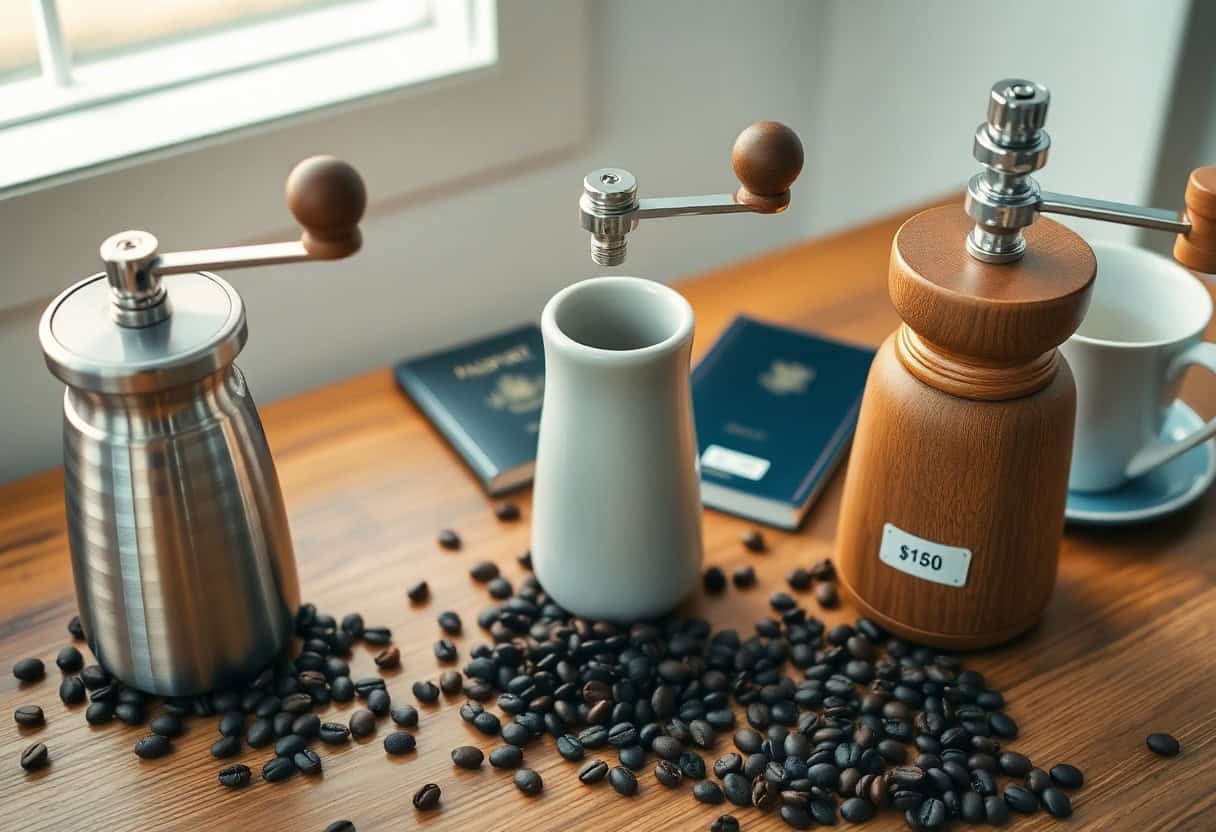
Material choice defines how your grinder feels in hand and performs over time. Stainless steel brings resilience and precision, resisting corrosion and wear even with daily use. Wooden bodies, while lighter and visually warm, require more care to avoid cracking from moisture or drops. Your pick shapes not only aesthetics but long-term reliability.
Portability for the Road
Travel demands a grinder that won’t weigh you down. Compact steel models under 12 ounces slip easily into backpacks without sacrificing stability. Look for designs with sealed burrs and locking mechanisms to prevent spillage. A lightweight wooden unit may save grams, but durability often pays greater dividends on the move.
Durability in the Kitchen
Steel grinders withstand years of daily grinding with minimal maintenance. Their sealed mechanisms resist coffee oils and humidity, preventing rust and clogging. Wooden models, while beautiful, can warp if left near sinks or in damp cabinets. For consistent performance in a home setting, steel’s resilience is unmatched.
Over time, steel’s resistance to impact and temperature shifts ensures grind consistency. You’ll notice fewer wobbles in the crank and longer burr life, especially with frequent use.
While wood adds charm, it demands dry storage and occasional oiling-steel simply works, day after day, with no special care.
The Timemore Chestnut C2
You’ll appreciate the Timemore Chestnut C2 for its reliable performance and thoughtful design that balances cost and quality. Engineered for both home use and travel, this grinder delivers a consistent grind size thanks to its 38mm conical burrs.
Its compact frame fits easily in a backpack, and the adjustable grind settings give you control across brewing methods. For a deeper comparison with other top models, check out
The 9 Best Manual Coffee Grinders in 2025 | No *BS Review.
Precision of the Burrs
Timemore’s 38mm stainless steel burrs produce a surprisingly even particle size, especially for the price. You’ll notice fewer fines or boulders, which means better extraction in your cup. The stepless adjustment lets you fine-tune your grind down to the smallest increment, giving you real control over flavor.
Speed of the Grind
Grinding takes moderate effort, but you’ll find it efficient for single servings. The handle’s design reduces wrist strain, letting you maintain a steady pace. While not the fastest, it strikes a practical balance between speed and consistency.
One full pour-over dose takes about 45-60 seconds, depending on your roast. You’ll appreciate the smooth action, especially when traveling light and brewing off-grid.
The Kingrinder K0
Minimalist Design
You’ll appreciate how the Kingrinder K0 fits easily into small kitchens or packed travel bags. Its sleek, no-frills body is built from lightweight aluminum, making it one of the most portable options under $80. There are no unnecessary parts-just a handle, burr set, and adjustable ring.
Every line serves a purpose, and the low-profile shape prevents tipping during grinding. You can disassemble it in seconds for cleaning, which is necessary for maintaining flavor purity on the go.
Consistent Coarseness
Each twist of the K0’s conical burrs delivers uniform particle size across pour-over, drip, or French press settings. You’ll notice fewer fines or boulders, which means better extraction and cleaner cups.
The 38mm burrs are precisely aligned at the factory, so you don’t waste time calibrating. This consistency holds whether you’re grinding at home or in a hotel room.
What makes the coarseness control truly reliable is the micro-adjustment ring beneath the burr. A slight turn fine-tunes your grind without guesswork, giving you repeatable results shot after shot. Few grinders in this price range offer this level of precision.
The Hario Skerton Pro
Glass and Grip
Its glass mill sits securely in a rubberized base, reducing slippage during grinding. You’ll appreciate the non-slip grip when applying pressure, especially on smooth surfaces. The lid fits snugly over the grinding chamber, minimizing bean spillage. While glass offers clarity and durability, avoid submerging the base in water to protect the seal.
Capacity for Two
This grinder handles enough coffee for two standard pour-overs with ease. You can grind up to 40 grams at once, making it ideal for shared mornings or travel pairings. The larger bowl capacity compared to its predecessor reduces refills and speeds up your brew session.
Having space for two servings means you won’t sacrifice freshness for convenience. It’s especially useful when camping or staying in a rental kitchen-no need to grind twice. Just measure, grind, and enjoy consistent results without bulk or clutter.
Choosing the Right Tool
Burrs Versus Blades
Blade grinders chop beans unevenly, producing inconsistent grounds that harm extraction and flavor. You’ll notice sour or bitter notes in your cup, especially with pour-over or espresso-style brewing. Burr grinders, by contrast, crush beans between two abrasive surfaces, delivering a uniform particle size that enhances clarity and balance. For travel and home use, a conical or flat burr hand grinder ensures precision without noise or power needs.
Price and Value
Spending under $80 doesn’t mean sacrificing performance. Many grinders in this range use high-quality steel burrs and ergonomic designs that rival pricier models. You’re paying for consistency, durability, and grind adjustability-not branding or unnecessary extras. Look for models with solid build quality and positive long-term user feedback.
Value emerges when a grinder lasts years while delivering café-quality results. Some budget options skimp on burr alignment or adjustability, leading to frustration over time. Your best bet is a model that balances affordability with thoughtful engineering, ensuring every grind supports your brewing goals-whether you’re on a mountain trail or in your kitchen.
The Ritual of the Morning
Why the Grind Matters
Every morning begins with a choice: how you start shapes what follows. The act of grinding your own beans transforms coffee from a routine into a moment of intention. When you use a manual grinder, you’re not just preparing a drink-you’re engaging your senses before the day truly begins. The sound of beans cracking, the slow turn of the burrs, the rising aroma-each step pulls you into the present. This isn’t about convenience; it’s about presence. With a quality hand grinder under $80, you gain control over particle size, ensuring your French press, pour-over, or AeroPress performs at its best. Consistency in grind size directly affects extraction, which means better-tasting coffee with every cup.
A Moment of Calm Before the Day
You don’t need a high-powered espresso machine or electricity to make exceptional coffee. In fact, removing those elements often deepens the experience. The quiet rhythm of hand grinding creates space-space to breathe, to think, or simply to be. There’s something grounding about the physical effort, a small resistance that reminds you you’re awake. This ritual slows time just enough to reset your focus before the world demands your attention. Whether you’re on a mountain trail or standing in your kitchen, that two-minute grind becomes a daily meditation. It’s not just about caffeine; it’s about starting with clarity and care.
Building a Habit That Lasts
Your morning doesn’t have to be complicated to be meaningful. A reliable manual grinder fits seamlessly into small kitchens, backpacks, and hotel drawers, making it easy to keep the ritual alive no matter where you are. The best models under $80 offer durable construction, precise adjustments, and smooth operation without breaking the bank. Over time, the repetition builds muscle memory, and the process becomes second nature. You’ll find yourself looking forward to that first twist of the crank, not because it guarantees perfect coffee-though it helps-but because it marks the beginning of your day on your own terms.
Final Words
Taking this into account, you now have a clear picture of the best manual coffee grinders under $80 that suit both travel and home use.
Each model discussed delivers consistent grind quality, compact design, and ease of use without compromising on performance. You can confidently choose one that aligns with your brewing preferences and lifestyle.
Your morning coffee deserves precision, and these grinders offer reliable results without stretching your budget. Whether you’re hiking or brewing at home, your grind consistency directly affects flavor-these tools put control in your hands.
Key Takeaways: Manual Coffee Grinders
- Buy manual coffee grinders with steel or ceramic burrs — burrs beat blades for even, repeatable grind.
- Judge manual coffee grinders on consistency — a stable axle and stepped adjustment keep grounds uniform.
- Match manual coffee grinders to your brewer — pick a grinder that dials from espresso-fine to French-press coarse.
- Value manual coffee grinders portability — compact bodies make these grinders ideal for travel.
- Weigh manual coffee grinders on price — under $80 buys serious quality if you skip the gimmicks.
Apply Manual Coffee Grinders to Your Setup
Once you pick from these manual coffee grinders, refine the rest of your brewing.
- Best coffee subscription services compared
- Nespresso vs Keurig honest comparison
- Best single serve coffee maker for one
For grind and extraction standards behind these manual coffee grinders, see the Specialty Coffee Association.
FAQs: Manual Coffee Grinders
Q: What makes a manual coffee grinder suitable for travel and home use?
A: A good manual coffee grinder for both travel and home should be compact, lightweight, and durable. It needs consistent grind quality across different settings, especially for pour-over, French press, or espresso-style brewing.
Look for models with ceramic or stainless steel burrs, an adjustable grind ring, and a design that minimizes grounds retention. Portability features like a built-in container or compatibility with standard brewing devices add convenience.
Q: Are manual grinders as effective as electric ones under $80?
A: Yes, many manual grinders in this price range deliver grind consistency comparable to entry-level electric models. They often use conical burrs made from ceramic or steel, which crush beans evenly without generating heat.
Since there’s no motor, they’re quieter, more portable, and require no power. The trade-off is hand-cranking effort, but for travelers or minimalist home users, the control and freshness outweigh the extra work.
Q: Which manual coffee grinder offers the best value under $80?
A: The Timemore C2 is widely praised for its balance of performance, build quality, and price. It features stainless steel conical burrs, 24 click-adjustable settings, and a clear grounds container.
Its ergonomic handle reduces wrist strain, and the design fits most popular brewing methods.
Other strong contenders include the 1ZPresso J-Max for finer grind control and the Handground Precision Grinder for ultra-fine espresso adjustments, though it sits near the top of the price range.
Q: Can I use a manual grinder for espresso on the go?
A: Some manual grinders can achieve a fine enough setting for portable espresso makers like the Flair or Minipresso. The 1ZPresso Q2 and J-Max models are known for their fine grind capability and tight calibration.
These grinders have stepped or stepless adjustments that allow precise tuning.
While hand grinding for espresso takes more time and effort than using an electric grinder, it’s entirely feasible for travelers who prioritize fresh grounds and don’t mind the extra minutes.
Q: How do I clean and maintain a manual coffee grinder?
A: Disassemble the grinder according to the manufacturer’s instructions-usually by removing the hopper, burr, and handle. Brush out coffee grounds with a small cleaning brush or dry cloth.
For deeper cleaning, use grinder cleaning tablets or uncooked rice to absorb oils (though rice is debated among users). Avoid water or liquids near the burrs unless specified by the maker.
Reassemble and grind a small amount of beans to clear any residue. Regular cleaning every few weeks keeps grind quality consistent and prevents clogging.