AI disclosure: this content, including any imagery, was artificially generated.
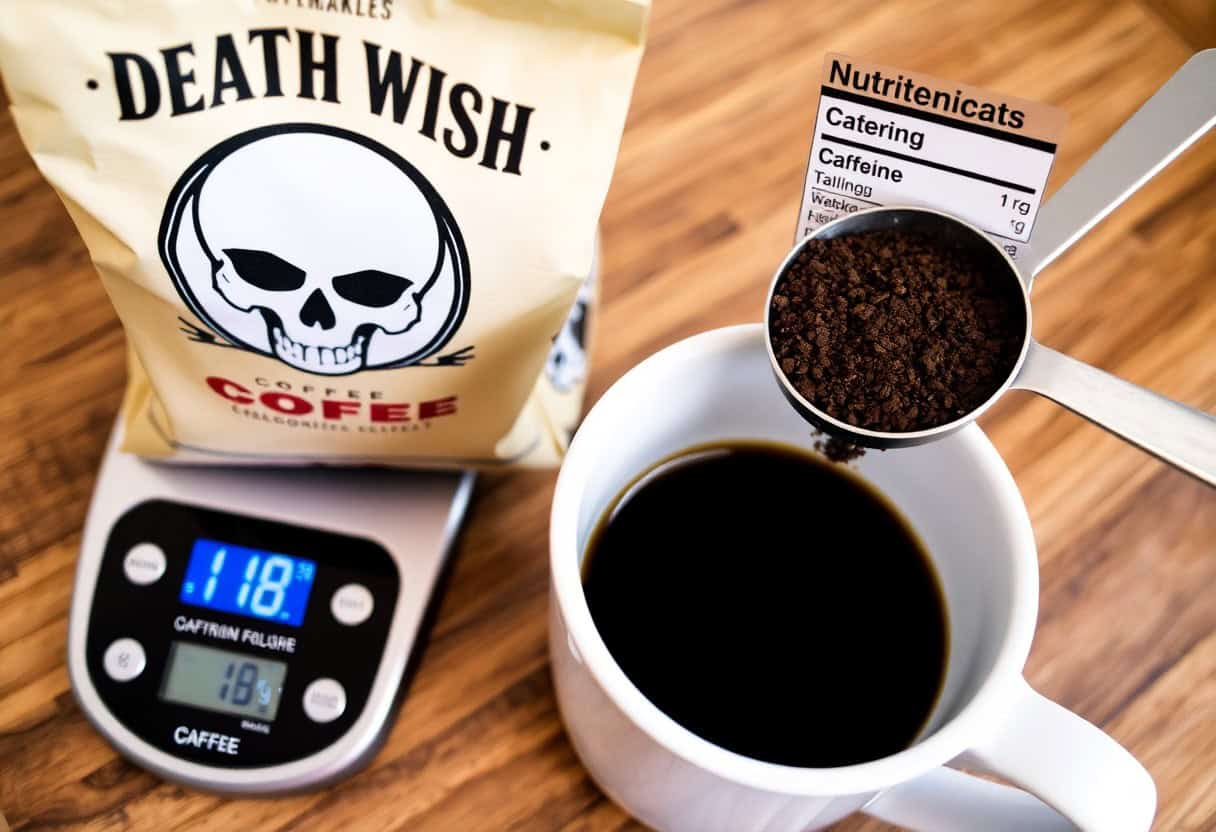
TL;DR: Death Wish Coffee packs roughly double the caffeine of a standard cup — and knowing exactly how much death wish coffee delivers per serving is the difference between a productive morning and a jittery afternoon.
Table of Contents
Many coffee drinkers turn to Death Wish Coffee for its bold flavor and powerful kick, but you should know it contains about 472 milligrams of caffeine per 12-ounce cup. That’s more than double the caffeine in a standard cup of coffee. While this high dose can boost alertness and focus, it may also lead to dangerous side effects like rapid heart rate or anxiety if consumed in excess.
Key Takeaways:
- Death Wish Coffee contains about 472 milligrams of caffeine per 12-ounce cup, making it one of the most caffeinated coffees on the market.
- The blend uses both Arabica and Robusta beans, with Robusta contributing significantly to the high caffeine content.
- Caffeine levels can vary slightly depending on brewing method, with espresso shots packing around 160 milligrams per 1.5 ounces.
- The FDA recommends a daily caffeine limit of 400 milligrams for most healthy adults, meaning one cup of Death Wish Coffee exceeds that guideline.
- Consumers should be cautious with portion size and frequency, as excessive caffeine intake can lead to jitteriness, increased heart rate, or sleep disruption.
Death Wish Coffee: The Search for the Dark Roast Truth
Claims of the World’s Strongest Bean
You’ve likely seen Death Wish Coffee marketed as the strongest coffee on the planet. The company claims it packs over 200% more caffeine than a standard cup of joe. Using a blend of Arabica and Robusta beans, roasted dark to amplify intensity, they aim for maximum punch. Each 12-ounce cup delivers about 472 milligrams of caffeine, a figure verified by third-party lab tests.
The Legend of the Skull and Crossbones
You might recognize Death Wish Coffee’s bold packaging-a black bag with a skull and crossbones emblem. This isn’t just for show. The symbol warns of its potentially dangerous caffeine levels, especially if consumed in excess. It reflects the brand’s rebellious tone while underscoring real risks tied to high caffeine intake.
Behind the skull lies a calculated message: respect the brew. The design echoes old poison labels, not to scare, but to inform. You’re meant to understand this isn’t your average morning coffee-it’s a high-stimulant product that demands caution, especially for those sensitive to caffeine or consuming multiple servings.
Measuring the Milligrams
Understanding how much caffeine is in Death Wish Coffee starts with precise measurement. Lab tests reveal that a standard 12-ounce cup brewed using their recommended method contains approximately 472 milligrams of caffeine. This places it among the most potent commercially available coffees on the market.
Laboratory Results vs Marketing
Lab analyses confirm Death Wish Coffee’s claim of high caffeine content, though exact numbers vary slightly by brewing method. While marketing states “double the caffeine of standard coffee,” verified tests show it’s close to twice as strong, depending on preparation. You should rely on independent data rather than slogans when assessing true potency.
The Standard Cup Comparison
Comparing Death Wish to average coffee highlights just how intense it really is. Most regular dark roast brews deliver about 200-260 mg per 12 oz. Death Wish surpasses them significantly, making it a serious choice for those seeking maximum stimulation.
| Death Wish Coffee | 472 mg |
| Average Dark Roast | 240 mg |
Seeing these numbers side by side underscores the dramatic difference. You’re consuming nearly double the caffeine in the same volume, which can impact heart rate, sleep, and anxiety levels-especially if you’re sensitive.
Independent Testing Variance
Independent labs have recorded results ranging from 450 to 500 mg per 12-ounce cup. These minor differences stem from grind size, water temperature, and brew time. You should expect slight fluctuations, but never below the high-stimulant threshold Death Wish is known for.
Multiple third-party tests confirm consistency across batches. Even with small variances, every result remains well above 450 mg, proving its reputation isn’t just hype-it’s measurable, repeatable, and powerful.
The Chemistry of the Kick
Death Wish Coffee earns its name through a deliberate blend of science and sourcing. You’re not just drinking caffeine-you’re consuming a precisely engineered jolt. The beans are selected and processed to maximize alkaloid concentration, particularly caffeine, which acts as a natural stimulant in coffee. What sets this brew apart isn’t just quantity, but how the entire profile-from bean type to roast-amplifies its potent neurological impact.
Robusta vs Arabica Blends
Robusta beans contain nearly double the caffeine of Arabica, and Death Wish leans heavily on this variety. You’ll find a blend dominated by Robusta, which delivers a sharper, more intense buzz. While Arabica is prized for smoothness, Robusta thrives under stress-growing at lower altitudes and resisting pests-making it naturally richer in stimulant compounds.
Roasting Levels and Potency
Roasting doesn’t burn off caffeine the way many assume. You might think darker roasts pack more punch, but caffeine remains largely stable through the roasting process. Death Wish uses a dark roast to deepen flavor, not to increase caffeine. The real power lies in the bean choice, not the char.
Dark roasting alters chlorogenic acids and oils, which can affect how quickly caffeine is absorbed. You may feel the kick faster due to these chemical shifts, even if the total caffeine stays constant. The roast enhances bioavailability, making the stimulant effect feel stronger than the numbers suggest.
The Origin of the Bean
Beans from regions like India and Peru form the backbone of Death Wish’s blend. You’re tasting beans grown in harsher, less fertile environments-conditions that stress the plant and trigger higher caffeine production as a natural defense. These origins are strategically chosen to maximize potency from the ground up.
High-altitude farms aren’t the focus here; instead, Death Wish sources from areas where Robusta thrives naturally. You’re getting beans evolved to survive-plants that invest energy into caffeine as protection. This biological reality means every sip carries a concentrated dose forged by nature, not just marketing.
Brewing for Maximum Impact
To unlock the full power of Death Wish Coffee, your brewing method matters as much as the beans. Review: Is Death Wish Coffee worth the hype? suggests that even the strongest beans fall short without proper technique. Precision in ratio, time, and temperature ensures you extract every bold, high-caffeine drop.
The Importance of the Ratio
Getting the coffee-to-water ratio right determines how intense your cup feels. Too little coffee dilutes the strength, while too much makes it unbearably bitter. Aim for 1 to 2 tablespoons per 6 ounces of water to balance potency and flavor.
This range maximizes caffeine extraction without overwhelming your palate.
Extraction Times and Heat
Water temperature between 195°F and 205°F pulls the most caffeine and flavor from Death Wish beans. Under-extraction leaves behind strength; over-extraction brings harshness.
Keep contact time precise-especially in drip or pour-over-to avoid losing what makes this coffee powerful.
Heat that’s too high scorches the grounds, muting the bold profile you want. Staying within the ideal range ensures a clean, aggressive cup. Timing varies by method, but 2 to 4 minutes is optimal for most manual brewing.
The French Press Method
French press enhances body and caffeine concentration due to full immersion. Use coarse grounds and steep for 4 minutes exactly-any longer and bitterness spikes. Press slowly to avoid agitating sediment. This method delivers one of the strongest, richest cups possible at home.
Because the metal filter allows oils and fine particles through, the French press amplifies mouthfeel and caffeine delivery. It’s a favorite for those chasing maximum impact without espresso gear. Just stick to the right ratio and timing to harness its full potential.
The Physical Cost of the Cup
Heart Rates and Jitters
You may feel your pulse quicken minutes after sipping Death Wish Coffee. With over 472 milligrams of caffeine per 12-ounce serving, your cardiovascular system responds rapidly.
Some users report elevated heart rates and unshakable tremors, especially on an empty stomach. Your body isn’t designed to process that much stimulant without consequence.
Even if you’re caffeine-tolerant, this level of intake can push you into uncomfortable territory. The jitters aren’t just annoying-they’re a warning sign.
Your nervous system is signaling stress, and ignoring it could lead to longer-term issues like anxiety or disrupted sleep cycles.
Staying Awake in the Dark
You might pride yourself on pulling all-nighters with Death Wish as your fuel. Its extreme caffeine content can delay sleep for hours, even if consumed in the early afternoon. Melatonin production drops sharply, disrupting your natural circadian rhythm.
Over time, this interference can lead to chronic sleep deprivation, weakening cognitive function and emotional resilience. You’re not conquering the night-you’re compromising your long-term health.
Pushing through fatigue with artificial stimulation creates a dangerous cycle. Each time you suppress tiredness, your body accumulates a deeper sleep debt. The most serious risks aren’t immediate-they’re the silent erosion of restorative rest, which no amount of caffeine can replace.
Market Rivals and Caffeine Counts
Comparing the Heavy Hitters
When measuring caffeine concentration, few brands challenge Death Wish Coffee’s 472 mg per 12 oz brew. Black Label from Devil Mountain edges slightly ahead at 500 mg, making it the only coffee with a higher count. Others like Biohazard and Extreme Coffee fall short, despite aggressive marketing.
| Brand | Caffeine (mg per 12 oz) |
|---|---|
| Death Wish Coffee | 472 |
| Devil Mountain Black Label | 500 |
| Biohazard Coffee | 415 |
| Extreme Coffee Co. | 330 |
Price per Milligram
You’re paying for potency, but not always efficiency. Death Wish costs about $0.026 per mg of caffeine, undercutting Devil Mountain’s $0.038 per mg despite the slight caffeine deficit. This makes Death Wish one of the most cost-effective high-caffeine options on the market.
Price per milligram reveals what marketing won’t-raw value. While some brands charge premium rates for marginally more caffeine, Death Wish balances strength and affordability. You get extreme caffeine without extreme markup, a rare win in the world of supercharged coffee.
Conclusion
Considering all points, Death Wish Coffee contains approximately 472 milligrams of caffeine per 12-ounce cup, making it one of the most highly caffeinated coffees available. You consume nearly five times the caffeine found in a standard cup of coffee with each serving.
You should approach this level of caffeine with caution, especially if you are sensitive to stimulants or consume other caffeinated products throughout the day. Understanding the actual caffeine content helps you make informed decisions about your intake and overall health.
Key Takeaways: Death Wish Coffee Caffeine
- Death Wish Coffee delivers about 728 mg per 12 oz cup — nearly double the FDA daily guideline in one mug.
- Compare death wish coffee to your usual brew — a standard cup runs 95-200 mg, so portion size matters.
- Brew method changes what death wish coffee gives you — drip extracts more caffeine than espresso per serving.
- Treat death wish coffee as an occasional tool, not a default — tolerance builds fast at this strength.
- Pair death wish coffee with food and water to blunt the crash and protect your sleep window.
Apply Death Wish Coffee Knowledge to Your Routine
Before you order a bag of death wish coffee, benchmark it against the brews you already drink.
- Black Rifle Coffee review — is it worth the price?
- Illy vs Lavazza — Italian coffee icons compared
- MUD WTR review — the low-caffeine alternative
For brewing standards and caffeine research, see the Specialty Coffee Association.
FAQs: Death Wish Coffee
Q: How much caffeine is in a typical 12-ounce cup of Death Wish Coffee?
A: A 12-ounce cup of Death Wish Coffee contains approximately 728 milligrams of caffeine. This amount is more than double the caffeine found in a standard cup of brewed coffee, which usually has around 300 milligrams.
The high caffeine content comes from a blend of Arabica and Robusta beans, with Robusta naturally containing nearly twice as much caffeine as Arabica.
Q: Is Death Wish Coffee the strongest coffee in terms of caffeine content?
A: Death Wish Coffee markets itself as one of the strongest coffees available, and its caffeine levels support that claim. With about 60.7 milligrams of caffeine per ounce, it ranks among the most caffeinated commercially available coffees.
However, some specialty or concentrated brews may exceed this level, especially when prepared with methods like espresso or cold brew concentrate.
Q: How does the caffeine in Death Wish Coffee compare to energy drinks or espresso?
A: A 12-ounce serving of Death Wish Coffee has about 728 milligrams of caffeine, far more than most energy drinks. For example, a 16-ounce can of a popular energy drink typically contains between 160 and 300 milligrams.
A single shot of espresso (1 ounce) has about 63 milligrams, so Death Wish Coffee delivers the caffeine equivalent of over 11 espresso shots in one 12-ounce cup.
Q: Can drinking Death Wish Coffee be dangerous due to its high caffeine content?
A: Consuming high levels of caffeine can pose health risks, especially for people sensitive to stimulants or with certain medical conditions.
The FDA suggests a daily limit of 400 milligrams for healthy adults, meaning one 12-ounce cup of Death Wish Coffee exceeds that by nearly double. Side effects may include jitteriness, increased heart rate, anxiety, or insomnia.
It’s best consumed in small amounts, if at all, and avoided by children, pregnant individuals, or those with heart concerns.
Q: Does the brewing method affect the caffeine level in Death Wish Coffee?
A: Yes, the brewing method can influence how much caffeine ends up in your cup. Death Wish Coffee recommends using a drip brewer or French press, and the 728-milligram figure is based on standard drip brewing with a 12-ounce serving.
Using a finer grind, hotter water, or longer brew time can extract more caffeine. Conversely, weaker brewing techniques or shorter contact time may result in slightly lower caffeine levels.