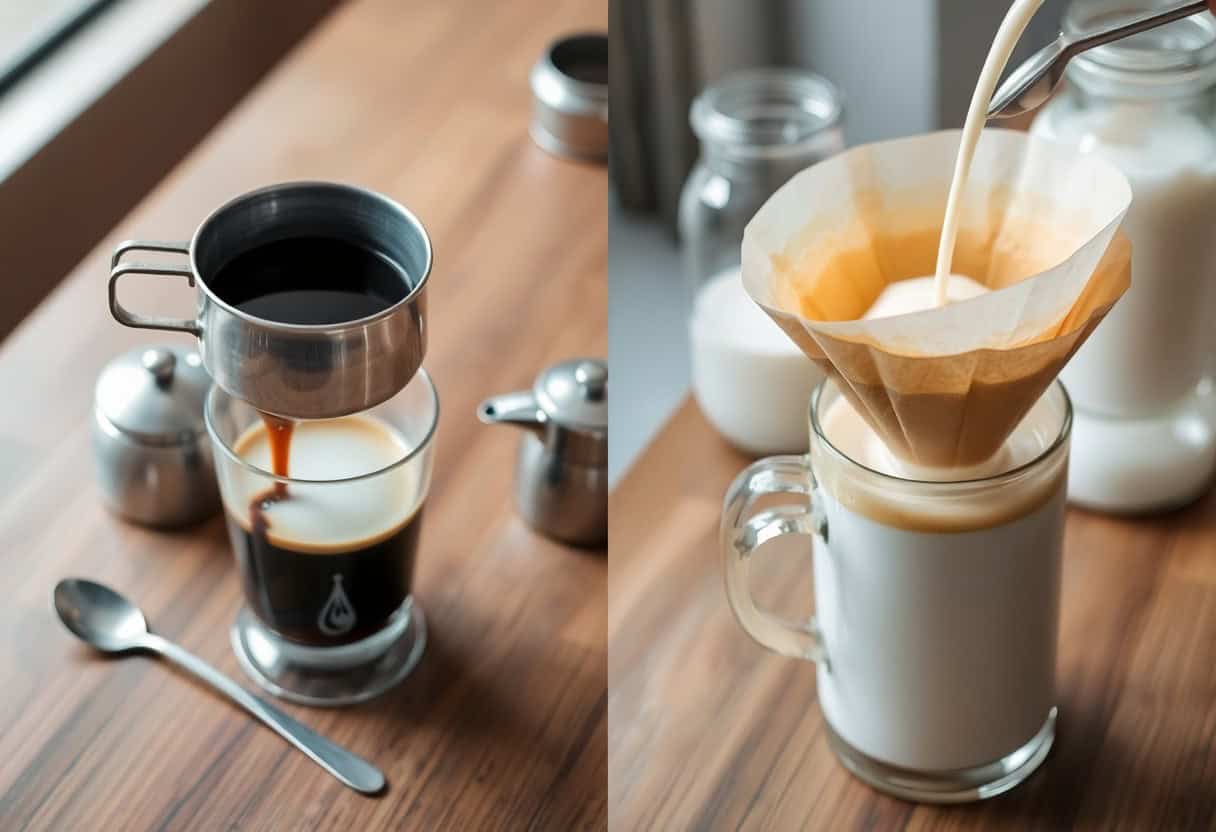
TL;DR — Vietnamese coffee: Vietnamese coffee at home with or without a phin filter. 7 steps and the condensed-milk ratio that nails the classic balance.
Table of Contents

TL;DR — Vietnamese coffee is one of the easiest brews to nail at home. With a phin filter you get the classic slow drip; without one, a small French press or AeroPress hits 90% of the way.
Vietnamese coffee works hot, iced, or as the famous condensed milk classic — and Vietnamese coffee at home costs pennies per cup.
Table of Contents
Over 30 seconds, hot water extracts bold, rich coffee through a traditional phin filter, delivering the distinctive slow drip that defines authentic Vietnamese coffee. You can achieve this strong, aromatic brew at home, even without a phin, using simple alternatives. The sweetened condensed milk at the bottom transforms each sip into a creamy, indulgent experience unique to this style.
Key Takeaways:
- Vietnamese coffee is traditionally made with a phin filter, a small metal drip device that slowly brews strong, concentrated coffee over hot water or ice.
- When using a phin filter, coarsely ground dark roast coffee-preferably Vietnamese brands like Trung Nguyen-delivers the bold, rich flavor characteristic of authentic ca phe sua da (iced coffee with sweetened condensed milk).
- For those without a phin, a French press or even a pour-over setup can mimic the slow drip process, though the flavor profile may vary slightly due to differences in extraction.
- Sweetened condensed milk is a signature component, stirred into the hot coffee before adding ice to create a creamy, sweet contrast to the bold brew.
- Brew time with a phin takes about 4-5 minutes; patience is key, as rushing the drip process can lead to weak or under-extracted coffee.
Essential Ingredients and Equipment
Every great cup of Vietnamese coffee starts with the right components. You’ll need coarsely ground coffee, sweetened condensed milk, hot water, and a brewing device-either a phin filter or an alternative method like a French press. The simplicity of the setup belies the depth of flavor possible when each element is chosen with care. Using authentic ingredients makes a noticeable difference in both aroma and taste.
How to Select the Right Coffee Beans: Robusta vs. Arabica
Robusta beans dominate Vietnamese coffee for good reason-they pack a bold, earthy punch and contain more caffeine than Arabica. Their intense flavor cuts through sweetened condensed milk, creating the signature balance Vietnamese coffee is known for. Most traditional recipes rely on 100% Robusta or a Robusta-Arabica blend.
Arabica offers smoother, fruitier notes but can get lost in the richness of condensed milk. If you prefer a milder cup, try a blend, but know that authenticity leans heavily toward Robusta. Always choose dark-roasted, coarsely ground beans labeled for phin brewing when possible.
The Role of Sweetened Condensed Milk in Traditional Recipes
Sweetened condensed milk isn’t just a sweetener-it’s the soul of traditional Vietnamese coffee. Developed when fresh milk was scarce, it adds creamy richness and a deep caramelized sweetness that balances the strong brew. Its thick texture enhances mouthfeel in a way granulated sugar never could.
You control the strength by adjusting the amount poured into your cup before brewing. Start with one to two tablespoons and tweak to taste. This ingredient transforms hot or iced coffee into something uniquely indulgent and deeply cultural.
Unlike regular milk or sugar, sweetened condensed milk caramelizes slightly under heat, deepening the coffee’s flavor profile as it brews.
It dissolves slowly, creating a layered sipping experience-from bold and intense at the top to creamy and sweet at the bottom. This gradual shift is part of what makes Vietnamese coffee so distinctive and satisfying.
Understanding the Components of a Phin Filter
A phin filter is a small, stainless steel device with four main parts: the chamber, press disc, filter lid, and base. Each plays a role in slow-drip brewing that extracts bold, concentrated coffee without bitterness. The tight filtration and gradual drip are key to its unique strength and smoothness.
Coffee grounds go in the chamber, the press disc sits on top to regulate water flow, and the lid keeps heat in during brewing. Resting the phin directly on your cup or mug ensures proper extraction. Its simplicity is part of its brilliance.
The phin’s design allows water to pass slowly through finely ground coffee, typically taking 4-5 minutes for a full brew. This extended contact time draws out intense flavor while minimizing acidity.
Because it requires no electricity or paper filters, it’s both economical and eco-friendly-perfect for home use or travel.
Key Factors for Achieving Authentic Flavor
To brew Vietnamese coffee that captures its true essence, you must focus on several core elements. The right balance of dark roast coffee, slow extraction, and sweetened condensed milk defines the drink’s signature profile. Use coarsely ground Robusta beans for boldness and crema-like texture. Always pre-wet the filter to maintain heat, and pour water in controlled stages. Assume that Vietnamese ice coffee recipe without a phin still demands attention to these fundamentals for success.
- Robusta beans deliver the intense flavor and caffeine punch typical in Vietnam
- Slow drip extraction enhances body and reduces bitterness
- Pre-wet filter stabilizes temperature for even brewing
- Sweetened condensed milk balances the strong, earthy notes
- Coarse grind size prevents clogging and over-extraction
Determining the Ideal Grind Size for Proper Extraction
Grind size directly impacts how water interacts with coffee grounds. Too fine, and you risk clogging the phin or creating bitter, over-extracted coffee. A coarse to medium-coarse grind allows steady, even dripping-vital for proper saturation and flow rate. This texture mimics sea salt, letting water pass gradually without rushing through. Assume that consistency in particle size prevents channeling and ensures full flavor development.
Calibrating Water Temperature for Optimal Heat Retention
Water that’s too hot burns the coffee, while water that’s too cool under-extracts. The ideal range is between 195°F and 205°F. This temperature preserves the aromatic oils and avoids scalding the grounds. Heat loss is rapid in a phin, so preheating the filter and cup helps maintain stability. Assume that thermal consistency supports a smooth, layered extraction.
| Factor | Optimal Condition |
|---|---|
| Water Temperature | 195°F – 205°F |
| Preheating | Filter and serving vessel |
| Heat Retention | Use of metal phin or insulated setup |
The Scientific Importance of the Initial Blooming Phase
Bloom time releases trapped carbon dioxide from freshly ground coffee. When hot water hits the grounds, gas escapes, creating bubbles. Skipping this step leads to uneven extraction and muted flavors. Allow 20-30 seconds after the first pour for the bloom to subside. Assume that this brief pause improves clarity and depth in your final cup.
| Phase | Effect on Brew |
|---|---|
| Blooming (20-30 sec) | Releases CO₂, improves water penetration |
| Gas buildup | Causes channeling if not released |
| Post-bloom saturation | Enables uniform extraction |
How to Brew Using a Traditional Phin Filter
Step-by-Step Assembly and Coffee Loading Techniques
Begin by placing the phin filter’s perforated plate into the chamber, ensuring it sits flat. This creates the foundation for even extraction.
| Component | Action |
| Perforated plate | Insert first to support grounds |
| Coffee grounds | Add 2-3 tablespoons of medium-fine grind |
| Pressing disc | Screw on gently-don’t over-tighten |
Mastering the Gravity Press and Water-to-Coffee Ratios
After loading, pour 1-2 tablespoons of hot water (just off boil) to initiate blooming. This saturates the grounds and starts extraction. Wait 30 seconds-do not rush-then fill the chamber to the top. The slow drip under gravity builds intensity. Use a 1:11 to 1:13 water-to-coffee ratio for balanced strength.
You control the flavor through patience. The press relies on gravity, not force, so never press down manually. Let physics work-this ensures clarity and avoids bitterness.
Timing the Drip for Maximum Strength and Clarity
Drip time should last 3 to 4 minutes for optimal extraction. If it finishes too fast, your grind may be too coarse; too slow, and it’s too fine. Watch the steady drops-a rhythmic pace means ideal strength and smoothness.
You’ll notice a rich, syrupy layer forming. This slow seep pulls out deep chocolate and caramel notes without sourness or burn.
How to Brew Without a Phin Filter
Adapting the French Press for Similar Body and Texture
You can mimic the rich texture of phin-brewed coffee using a French press. Start with a coarse grind and a 1:10 coffee-to-water ratio for concentrated strength. Pour hot water just off the boil, stir gently, and let it steep for four minutes. Press slowly to avoid over-extraction and pour immediately over ice or hot water. This method delivers a bold, full-bodied cup close to traditional Vietnamese style.
Utilizing a Moka Pot to Achieve High Coffee Concentration
A Moka pot produces a strong, espresso-like brew ideal for Vietnamese coffee. Fill the bottom chamber with hot water to the safety valve and use a medium-fine grind in the filter basket. Never tamp the coffee-just level it. As the pot brews on medium heat, it forces water through the grounds, yielding a concentrated shot. The result is intense and aromatic, perfect for mixing with sweetened condensed milk.
Once brewed, the Moka pot’s output closely resembles the strength of phin-filter coffee, making it a reliable alternative. Transfer the hot concentrate directly into your glass with condensed milk to create the signature sweet, bold flavor. Use dark roast beans for authenticity and deeper chocolate or caramel notes that balance the sweetness. This method works especially well when serving hot, preserving the traditional warmth and intensity.
Expert Tips for Improving Your Brew
Perfecting your Vietnamese coffee starts with using freshly ground beans at the right coarseness-too fine and you risk clogging, too coarse and the brew will be weak. Always pre-wet the phin filter to eliminate paper taste and stabilize temperature. Use water just off the boil, around 195-205°F, for optimal extraction. Apply gentle, even pressure when pressing the filter lid-never force it down. Let the drip process unfold slowly; a full draw should take 4 to 5 minutes. Thou can turn a good cup into an exceptional one with patience and precision.
- Use dark roast Arabica or Robusta beans for authentic flavor
- Grind fresh to preserve aroma and strength
- Control water temperature to avoid bitter or sour notes
- Adjust grind size if drip rate is too fast or slow
- Always use filtered water for a cleaner coffee profile
Troubleshooting Common Extraction and Flow Rate Errors
Slow drips often mean your grind is too fine or you’ve over-packed the phin chamber. If coffee rushes through in under two minutes, the grind is too coarse. Uneven saturation can cause channeling, leading to weak or bitter results. Always pour water in a slow spiral to wet all grounds evenly. Thou can fix most issues by adjusting grind size and distribution.
Proper Cleaning and Maintenance of Metal Filters
Residue buildup in the metal disk reduces flow efficiency and taints flavor over time. Rinse the filter immediately after use to prevent oils from hardening. For deep cleaning, soak it in warm water with a drop of dish soap, then scrub gently with a soft brush. Always inspect the mesh for clogs or warping. Thou can extend the life of your phin filter with consistent care.
Over time, coffee oils polymerize and create rancid notes in your brew if left uncleaned. A neglected metal filter may also warp from heat stress, disrupting the seal and altering drip dynamics. Regular maintenance ensures consistent extraction and protects the integrity of each cup. Use only non-abrasive tools to preserve the fine mesh-this small habit makes a noticeable difference in flavor clarity and longevity of your equipment.

Popular Serving Styles and Customizations
Preparing the Iconic Cà Phê Sữa Đá (Iced Coffee)
Start by filling a glass with ice and pouring 2-3 tablespoons of sweetened condensed milk into the bottom. Slowly add the freshly brewed Vietnamese coffee over the milk, letting it cascade over the ice for a layered effect. The contrast of strong coffee and creamy sweetness defines this beloved drink, making it a go-to choice in homes and cafés across Vietnam.
Crafting the Luxurious Cà Phê Trứng (Egg Coffee)
Beat one fresh egg yolk with condensed milk until thick and frothy, creating a velvety foam unique to Hanoi’s specialty. Pour hot coffee into a small cup, then gently spoon the yolk mixture on top. The rich, custard-like layer floats like edible silk, offering a decadent twist on traditional brews.
You’re sipping a wartime invention born from milk shortages-chefs used egg yolks as a creamy substitute. This version isn’t just indulgent; it’s a taste of history. Always use fresh eggs from trusted sources, as the yolk is consumed raw, making quality imperative for both flavor and safety.
To wrap up
Upon reflecting on how to make Vietnamese coffee, you now have the tools to brew it with or without a phin filter. Using a phin delivers the traditional slow drip method, intensifying the bold, rich flavor that defines the drink.
Without one, a French press or instant dark roast can still yield a satisfying result when prepared with condensed milk for authenticity. You control the strength and sweetness to match your taste.
Mastering this coffee style connects you to a long-standing tradition rooted in patience and balance. Your daily brew doesn’t need special equipment to be authentic-it needs attention to detail and respect for the process.
Key Takeaways: Vietnamese Coffee
- Use dark, oily robusta or robusta-arabica blend — authentic Vietnamese coffee starts with the beans, not the brewer.
- A phin is the traditional Vietnamese coffee tool — but a French press or AeroPress runs a close second.
- Sweetened condensed milk is the soul of Vietnamese coffee — 2 tablespoons per cup is the home-bar standard.
- Vietnamese coffee iced (ca phe sua da) is a summer staple — same brew, poured over ice with the condensed milk.
- Strong coffee plus sweet milk is the Vietnamese coffee formula — keep the ratios and the recipe is forgiving.
Brew Vietnamese Coffee Tomorrow Morning
Three short reads to round out a Vietnamese coffee morning ritual.
For brewing science and bean sourcing standards, see the Specialty Coffee Association.
FAQs: Vietnamese Coffee
Q: What ingredients do I need to make traditional Vietnamese coffee?
A: You need coarsely ground dark roast coffee, preferably Vietnamese-style robusta beans, sweetened condensed milk, and hot water. A standard serving uses 2 to 3 tablespoons of coffee and 1 to 2 tablespoons of condensed milk, depending on taste.
Freshly boiled water is crucial to extract the full flavor through the slow drip process.
Q: How do I use a phin filter to make Vietnamese coffee?
A: Start by placing 2 to 3 tablespoons of coarsely ground coffee into the phin filter chamber. Do not tamp it down-just level it gently. Screw the press disc on top until it’s snug but not tight.
Place the filter over a cup or glass, add 1 to 2 tablespoons of condensed milk to the cup, then pour a small amount of hot water (just off the boil) over the coffee grounds to let it bloom for 20-30 seconds.
Fill the chamber with hot water, cover with the lid, and let it drip slowly. The full brew takes 3 to 5 minutes. Stir well before drinking.
Q: Can I make Vietnamese coffee without a phin filter?
A: Yes, you can use a French press, pour-over, or even a small metal mesh strainer. For a French press, add 2 to 3 tablespoons of coarse grounds, pour in hot water, stir, and steep for 4 minutes before pressing.
Mix the brewed coffee with condensed milk in your serving glass. With a pour-over, use a paper filter and medium-coarse grounds, adjusting the ratio to match the strength of phin-brewed coffee.
The key is achieving a strong, bold cup that balances well with sweetened condensed milk.
Q: Why is sweetened condensed milk used in Vietnamese coffee?
A: Sweetened condensed milk became popular in Vietnam during the mid-20th century when fresh milk was scarce. The thick, sweet milk complements the strong, bitter notes of dark roast robusta coffee.
It adds creaminess and sweetness without needing refrigerated dairy. The contrast between the bold coffee and rich milk creates the drink’s signature taste.
You can adjust the amount to suit your preference or try alternatives like coconut milk or plant-based condensed milk.
Q: What’s the best type of coffee bean for authentic Vietnamese coffee?
A: Authentic Vietnamese coffee typically uses dark roasted robusta beans, which are stronger, more bitter, and higher in caffeine than arabica.
Many traditional blends mix robusta with a small amount of arabica or added flavors like chicory, cocoa, or butter for depth. Look for brands like Trung Nguyen, Vinacafe, or Cafe Du Monde (which includes chicory) for an authentic profile.
The beans should be ground to a coarse consistency, similar to sea salt, to ensure proper extraction in a phin filter.
Key Takeaways: Vietnamese coffee
- Pick the right Vietnamese coffee — match the brew method to the bean origin for the best cup.
- Time the Vietnamese coffee — extraction time is the single biggest flavour lever you control.
- Grind for the Vietnamese coffee — coarse for press, fine for espresso, in between for everything else.
- Water temp for Vietnamese coffee — 92-96°C is the sweet spot for full extraction without bitterness.
- Ratio drives Vietnamese coffee — 1:15 to 1:18 coffee-to-water nails balance for most brew styles.
Apply Vietnamese coffee to Your Morning
Pick one variable to change this week and brew the Vietnamese coffee the same way for seven days. Taste, log, then adjust.
- How to Make an Iced Latte at Home in Under 5 Minutes
- The Complete Guide to Coffee Brewing Methods (14 Ways, Ranked by Effort)
- The Complete Guide to Coffee Beans – Origin, Roast, Grind, and Storage
For deeper standards on Vietnamese coffee, see the Specialty Coffee Association.
FAQs: Vietnamese coffee
What is the easiest Vietnamese coffee for a beginner? The French press is the gentlest start — almost impossible to over-extract, gives a full-bodied cup, and needs no special gear.
How much does Vietnamese coffee setup cost? A solid home rig starts around £80 for grinder, kettle, and one brew device — under £200 covers nearly any method short of espresso.
Does Vietnamese coffee keep overnight? Brewed coffee loses character within 30 minutes. Brew fresh, or cold-brew the night before for an iced drink the next morning.