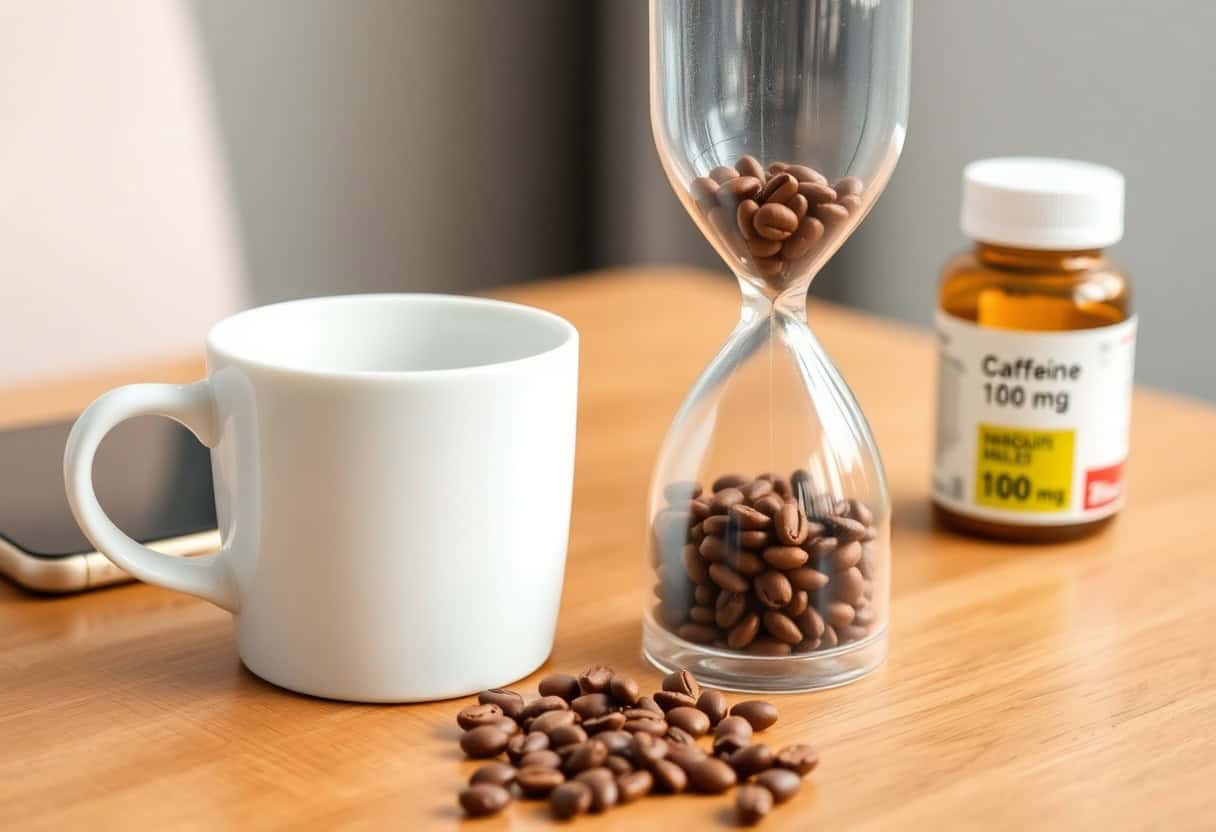
TL;DR: Caffeine half-life is roughly 5 hours, but yours could be anywhere from 1.5 to 9.5 hours depending on liver enzymes, smoking status, pregnancy, and oral contraceptives. Knowing your caffeine half-life is the difference between a 6 AM espresso that fades by 3 PM and one that’s still pulsing at 11 PM. This guide breaks down caffeine half-life science with 7 proven truths and the cutoff times that match yours.

Table of Contents
Most people don’t realize how long caffeine lingers in their body after that morning cup.
The average half-life of caffeine is 5 hours, meaning half the caffeine remains in your system that long.
Up to 10 hours later, it can still affect sleep, while complete elimination may take over 12 hours. Your metabolism, age, and medications influence this timeline.
Key Takeaways:
- Caffeine has a half-life of about 3 to 5 hours in most adults, meaning it takes that long for half of the caffeine consumed to be eliminated from the body.
- Individual factors like age, liver function, pregnancy, and genetics can significantly affect how long caffeine stays in your system.
- Even after caffeine levels drop, its effects may still be felt, especially in people sensitive to stimulants or those who consume it later in the day.
- Smoking can shorten caffeine’s half-life, while certain medications and oral contraceptives may extend it.
- It can take up to 10 to 12 hours for caffeine to be almost completely cleared from the body, which is why timing your coffee intake matters for sleep quality.
Caffeine Half-Life: The Mechanics of the Five Hour Mark
The Definition of Half-Life
Half-life measures how long your body takes to eliminate half of a substance. For caffeine, this typically lands around five hours, though it varies by individual.
You absorb caffeine quickly, and its effects peak within 30 to 60 minutes. From there, your liver begins breaking it down, reducing its concentration steadily.
This means if you drink a 200 mg cup of coffee, about 100 mg remains after five hours.
Residual Caffeine in the Blood
Even at the five-hour mark, residual caffeine continues to circulate in your bloodstream. Though diminished, it can still affect alertness, heart rate, and sleep quality.
Your sensitivity determines how noticeable these effects are. Some people feel jittery or restless hours later, while others notice little change.
Your liver enzymes, genetics, and habits like smoking or medication use influence how fast you process caffeine.
For example, pregnant individuals or those on certain medications may experience a prolonged half-life, keeping caffeine active in the blood well beyond five hours.
This lingering presence explains why afternoon coffee can disrupt nighttime rest.
The Liver and the Enzyme
Your liver plays a central role in determining how long caffeine affects you.
Once caffeine enters your bloodstream, it travels to the liver, where it’s broken down by a specific enzyme known as CYP1A2.
This enzyme is responsible for metabolizing over 90% of the caffeine you consume, turning it into compounds your body can eliminate.
Without this process, caffeine would linger far longer, increasing the risk of side effects like insomnia, anxiety, and elevated heart rate.
Function of the CYP1A2
CYP1A2 is the primary enzyme your liver uses to process caffeine. It initiates the breakdown of caffeine into three metabolites: paraxanthine, theobromine, and theophylline.
Each of these has mild stimulant effects, but they’re easier for your body to clear.
The speed of this conversion directly influences how quickly you feel alert and how long those effects last.
Slower enzyme activity means caffeine stays active in your system longer, potentially disrupting sleep even if consumed hours earlier.
Genetic Speed of Processing
Your DNA determines how efficiently CYP1A2 works. Some people carry genetic variants that make the enzyme fast-acting, allowing them to metabolize caffeine quickly.
Others have a slower version, causing caffeine to remain in their system for up to 10 hours or more.
This genetic difference explains why one person can drink coffee at 5 p.m. and sleep soundly, while another feels jittery hours after a morning cup.
Slow metabolizers face a higher risk of increased blood pressure and cardiovascular strain with regular caffeine intake.
If you’re sensitive to coffee or notice prolonged stimulation, you may carry the slow-metabolizing variant.
Genetic testing can reveal your type, helping you make informed choices about timing and dosage for better health outcomes.
External Variables of Metabolism
How your body processes caffeine isn’t just about genetics-outside factors play a major role.
Certain medications, lifestyle habits, and even hormonal states can slow or accelerate caffeine clearance.
These influences mean two people drinking the same coffee may feel its effects for very different lengths of time.
Effects of Tobacco Use
Smoking speeds up how quickly your liver breaks down caffeine. Tobacco induces enzymes like CYP1A2, which metabolize caffeine faster, cutting its half-life by up to 30-50%.
That means if you smoke, coffee may give you a shorter boost. But don’t mistake speed for safety-this faster clearance can lead to increased consumption to maintain alertness.
Influence of Birth Control
Using oral contraceptives dramatically slows caffeine metabolism. Estrogen in birth control can double caffeine’s half-life, extending its presence from 5 hours to over 10.
This means you may feel jittery longer and sleep more poorly-even from a morning cup. Sensitivity increases, so smaller doses may be necessary.
When estrogen suppresses CYP1A2 enzyme activity, caffeine lingers in your system much longer. This prolonged exposure can amplify side effects like anxiety or insomnia.
If you’re on hormonal birth control, consider limiting intake to earlier in the day and avoid exceeding 200 mg to maintain sleep quality and reduce discomfort.
Even one afternoon espresso could disrupt your night.
The Obstruction of Sleep
Caffeine disrupts your natural sleep cycle by blocking the brain’s ability to wind down at night.
Even if you fall asleep after drinking coffee late in the day, your body may not reach the restorative phases needed for true recovery.
This interference often goes unnoticed, making you feel rested when you’re not.
Adenosine Receptor Interference
Adenosine builds up in your brain throughout the day, signaling tiredness by binding to its receptors.
Caffeine mimics adenosine’s shape, occupying these receptors without activating them, effectively silencing your body’s fatigue signals.
You stay alert, but your brain’s need for rest doesn’t disappear-it only gets masked, delaying sleep onset and reducing total sleep time.
Quality of the Deep Rest
Deep sleep is vital for memory consolidation and physical recovery. Caffeine reduces the time you spend in this critical phase, even if you’re asleep for eight hours.
You might not wake up feeling unrested, but your cognitive performance and mood can still suffer the next day.
Your brain needs uninterrupted slow-wave sleep to flush out toxins and repair neural pathways. When caffeine lingers in your system, it fragments these processes.
Sleep may look sufficient in duration, but its quality drops significantly, undermining long-term brain health and daily focus.
Pregnancy and Systemic Delay
During pregnancy, your body processes caffeine much more slowly due to hormonal and metabolic changes.
The half-life of caffeine can double or even triple, especially in the later trimesters, meaning a single cup of coffee may linger in your system for up to 15 hours or more.
This extended exposure can affect both you and your developing baby, potentially influencing fetal heart rate and sleep patterns.
Extended Duration in the Body
Pregnant individuals experience a significant delay in caffeine clearance, primarily because the liver enzyme responsible for breaking it down-CYP1A2-is suppressed. As a result, caffeine accumulates more easily, increasing the risk of adverse outcomes like low birth weight. Learn more about how this stimulant impacts your long-term well-being at Is Caffeine Affecting Your Sleep and Heart Health? – PCNA.
Planning the Last Cup
Knowing when to stop drinking coffee can make the difference between restful sleep and nighttime restlessness. Since caffeine has a half-life of about 5 hours, the choices you make at noon affect your body well into the evening. Timing your last cup wisely supports both alertness and sleep quality.
Calculation of the Cutoff Time
To determine your cutoff time, start by identifying your bedtime. Subtract at least 8 to 10 hours to ensure caffeine doesn’t interfere with falling asleep.
For example, if you sleep at 10 p.m., your last coffee should be no later than 12 p.m. to 2 p.m. Even small amounts in the late afternoon can delay sleep onset.
Management of the Afternoon Slump
When energy dips after lunch, resist reaching for another espresso. Caffeine consumed past 2 p.m. often disrupts sleep, even if you don’t feel jittery.
Instead, try a short walk, hydration, or a protein-rich snack to regain focus naturally.
You might think a late pick-me-up helps productivity, but the cost is often poorer sleep quality and next-day fatigue.
Your body’s natural circadian dip around 2-4 p.m. is temporary-pushing through with caffeine creates a cycle that’s hard to break.
Choosing non-stimulant strategies protects your long-term energy balance.
To wrap up
Caffeine typically stays in your system for about 5 hours, but this can vary based on your metabolism, age, and liver function.
You may feel the stimulating effects for several hours after your last sip, but traces of caffeine can linger much longer, potentially affecting sleep or anxiety levels.
How your body processes coffee determines how long it truly impacts you.
Your individual response to caffeine plays a major role in how long it remains active.
Pregnant individuals, those with certain medical conditions, or people on specific medications may experience a prolonged half-life.
Choosing when and how much coffee to consume means considering not just immediate energy, but how it affects your body hours later.

Key Takeaways: Caffeine Half-Life
- Average caffeine half-life is ~5 hours — half the dose is still in your bloodstream that long after the cup.
- Your caffeine half-life can be 1.5–9.5 hours — CYP1A2 liver enzyme variation drives this range.
- Smoking shortens caffeine half-life — roughly halves it via enzyme induction.
- Pregnancy and contraceptives lengthen caffeine half-life — sometimes to 10+ hours.
- Use caffeine half-life to set your cutoff — last cup 8–10 hours before sleep for most adults.
Apply Caffeine Half-Life to Your Routine This Week
Use these caffeine half-life rules to fix your afternoon crash and your sleep in the same move:
- Coffee and brain health — what neurologists say about caffeine half-life
- Tillvio French press — brews lower caffeine half-life cups
- Kona manual grinder — control your dose for caffeine half-life
For independent industry guidance on coffee science, see the Specialty Coffee Association.
FAQs: Caffeine Half-Life
Q: How long does caffeine stay in your system after drinking coffee?
A: Caffeine typically has a half-life of about 3 to 5 hours in healthy adults.
This means that if you consume 200 mg of caffeine, roughly 100 mg will still be in your bloodstream after 5 hours.
It usually takes around 10 to 12 hours for most of the caffeine to be eliminated, though trace amounts can remain for up to 24 hours depending on individual metabolism, age, liver function, and other factors.
Q: What factors affect how long caffeine stays in your body?
A: Several factors influence caffeine metabolism. Liver enzymes, especially CYP1A2, play a major role in breaking down caffeine.
People with higher enzyme activity process caffeine faster.
Other factors include age (older adults metabolize it slower), pregnancy (can extend half-life to 10-15 hours), smoking (speeds up clearance), certain medications (like birth control or fluvoxamine), and genetics.
Body weight and hydration levels also have minor effects.
Q: Can caffeine affect sleep even if consumed in the morning?
A: Yes. Even if you drink coffee early in the day, it can still interfere with sleep for people who are sensitive to caffeine or have a slower metabolism.
Since caffeine blocks adenosine receptors-chemicals that promote sleepiness-its stimulating effects can linger.
Some individuals may feel alert hours later, making it harder to fall asleep or reducing sleep quality, even if they don’t feel “wired” at bedtime.
Q: Does everyone process caffeine at the same rate?
A: No. Caffeine metabolism varies widely between individuals.
Genetic differences explain why some people can drink coffee at dinner and fall asleep easily, while others can’t have it after noon.
About 10% of people are “slow metabolizers” due to variations in the CYP1A2 gene.
These individuals may experience longer-lasting effects and higher risks of side effects like anxiety, increased heart rate, or disrupted sleep.
Q: How can I reduce the effects of caffeine if I’ve had too much?
A: There’s no way to instantly remove caffeine from your system, but you can manage its effects. Drink water to stay hydrated, as caffeine is a mild diuretic.
Eat a balanced snack to slow absorption and stabilize energy levels. Light physical activity like walking may help burn off excess energy. Avoid more caffeine.
In extreme cases, rest in a quiet space and practice deep breathing to calm your nervous system. Time is the only true remedy as your liver processes the compound naturally.